
Case Study · Government · Public Sector
Ministry of Energy, Thailand
Government Cloud Migration & Secure Digital Foundation
ACustomer Overview
Who is the Customer
The Ministry of Energy of the Kingdom of Thailand (กระทรวงพลังงาน) is the government body responsible for formulating and executing national energy policy, overseeing energy infrastructure, and managing the country's natural resource portfolio — spanning electricity, natural gas, and renewable energy sectors.
As a central government ministry serving both policy makers and the public, the Ministry operates multiple mission-critical digital systems supporting regulatory functions, internal operations, and citizen-facing services. With an expanding digital mandate and growing infrastructure obligations, the Ministry engaged Trade Square to plan and deliver a full transition to cloud infrastructure.
| Organisation Type | Government Ministry — Kingdom of Thailand |
|---|---|
| Sector | Energy · Public Sector |
| Headquarters | Bangkok, Thailand |
| Cloud Partner | Trade Square Co., Ltd. |
| Cloud Platform | Amazon Web Services — Thailand Region |
| Engagement Period | November 2025 – 2026 |
BBusiness Context
Challenges & Strategic Drivers
The Ministry's decision to migrate was driven by a convergence of operational, regulatory, and strategic pressures that made maintaining on-premises infrastructure increasingly untenable. Several factors created a defined and non-negotiable migration timeline.
Infrastructure End-of-Life
On-premises servers were approaching vendor end-of-support, eliminating the availability of security patches and technical assistance. Continued operation on unsupported infrastructure represented an unacceptable risk to government operations and data integrity.
Data Centre Lease Expiry
The Ministry's primary data centre lease was set to expire, establishing a firm and immovable deadline for the decommission of all on-premises workloads — with no option to extend the tenancy.
NCSA Compliance Obligations
As a government ministry, the organisation is subject to Thailand's National Cyber Security Agency (NCSA) standards. Legacy infrastructure lacked the automated controls, audit capability, and security architecture required to demonstrate ongoing compliance.
Inadequate Business Continuity
The Ministry had no formal disaster recovery framework for its most critical systems. Recovery time objectives for key government services were measured in hours, exposing the organisation to significant operational risk in the event of system failure.
Security Visibility Gaps
There was no centralised mechanism for monitoring threats or maintaining unified security visibility across the Ministry's digital environment — limiting the ability to detect, respond to, and report on security events in line with NCSA and government accountability requirements.
CEngagement Approach
Solution
Trade Square designed and delivered a structured, phased cloud migration programme — establishing a government-grade, multi-account cloud architecture as the foundation, before executing workload migration in controlled, validated waves. NCSA compliance and security controls were embedded into the architecture at every layer, rather than applied retrospectively.
| Phase | Description |
|---|---|
| Phase 01 — Assessment | Infrastructure discovery, migration strategy definition, and business case development. |
| Phase 02 — Foundation & Pilot | NCSA-compliant cloud architecture, security baseline, and pilot migration with validation. |
| Phase 03 — Full Migration | Wave-by-wave migration of all remaining workloads, culminating in data centre decommission. |
| Ongoing — Operations & Optimisation | Managed support, cost optimisation, and periodic architecture reviews. |
Architecture & Design Pillars
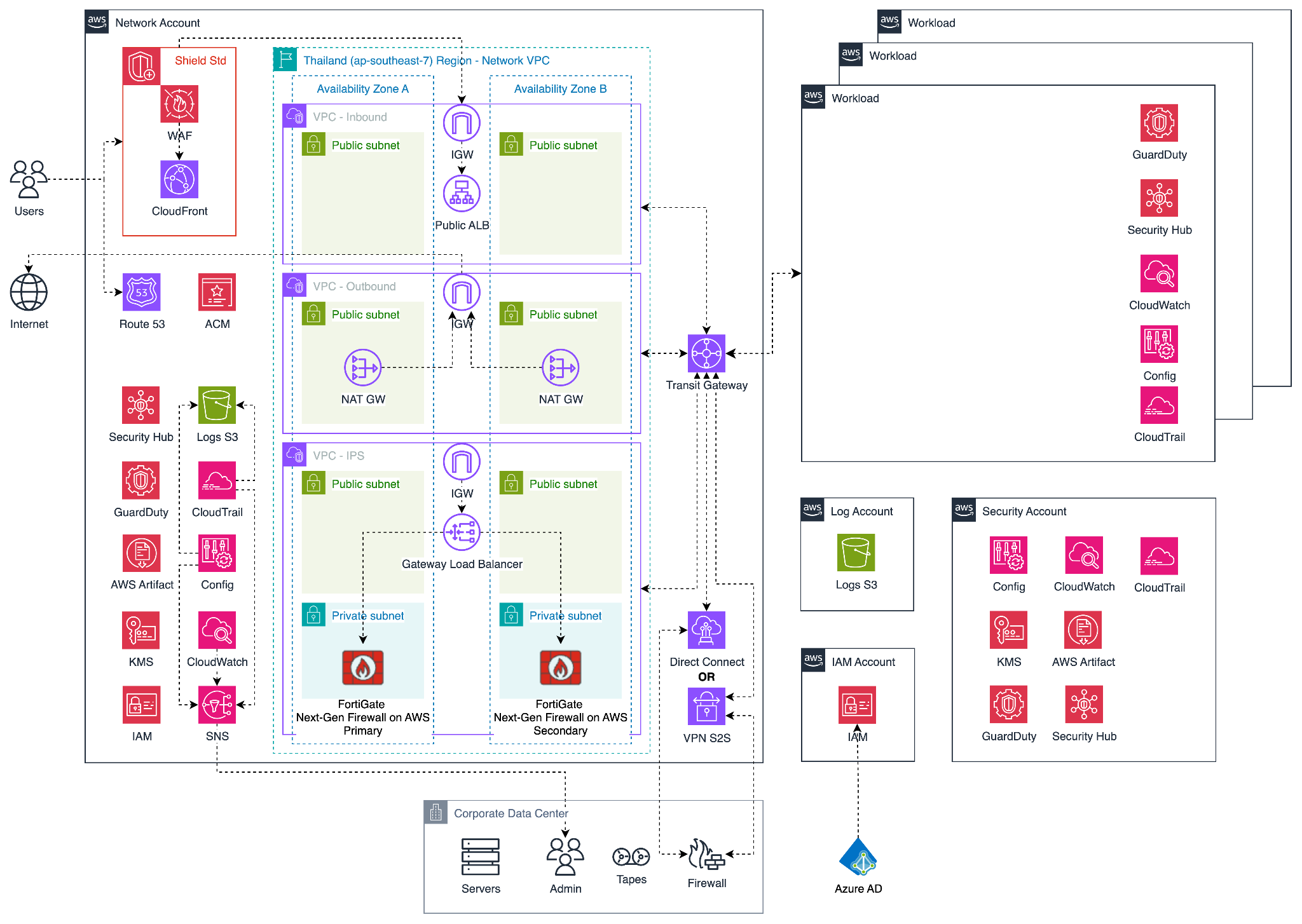
Multi-Account Cloud Architecture
- Dedicated accounts for network, security, identity, and workloads — enforcing clear operational and compliance boundaries
- Centralised network hub with next-generation firewall and redundant connectivity
- Policy-driven governance applied consistently across all accounts
NCSA-Compliant Security Design
- Continuous threat detection and monitoring aligned to NCSA security requirements
- Encryption enforced for all government data at rest and in transit
- Data residency controls enforced at the platform policy level
- Tamper-proof audit logging supporting NCSA accountability obligations
Structured Workload Migration
- Server migrations executed in validated, sequenced waves with rollback procedures
- Database modernisation to fully managed cloud database services
- All cutover windows approved through formal change management processes
- Application owner sign-off obtained at each wave before proceeding
Resilience & Business Continuity
- Multi-availability zone deployment for all Tier-1 government systems
- Automated failover reducing recovery time objectives from days to hours
- Disaster recovery architecture aligned to NCSA and government service requirements
Cloud Architecture — Thailand Region: NCSA-compliant multi-account cloud architecture with Network, Security, Identity & Workload accounts, centralised security controls, next-generation firewall, and redundant connectivity (see diagram above).
DBusiness Outcomes
Results & Impact
The engagement delivered against each of the five strategic priorities defined at the outset. Outcomes below correspond directly to the challenges that drove the migration programme.
Infrastructure Modernisation Delivered
All in-scope servers have been migrated or are on a committed schedule for migration. The Ministry has fully eliminated its dependency on end-of-life hardware, removing the associated security and operational risk from its environment.
Data Centre Exit on Track
The migration programme is structured to achieve full data centre decommission within the required timeframe. Pilot workloads are live, and the remaining waves are sequenced and scheduled to meet the lease deadline.
NCSA Compliance Achieved by Architecture
NCSA security requirements are enforced automatically through the cloud platform — including mandatory encryption, access controls, centralised audit logging, and continuous compliance monitoring. Compliance is now an inherent property of the architecture, not a manual process subject to human error.
Resilience & Recovery Significantly Improved
Critical government systems now operate with multi-availability zone redundancy and automated failover. Recovery time for key services has been reduced from several days to hours — materially strengthening the Ministry's business continuity posture and reducing the risk of prolonged service interruption.
Centralised Security Governance Established
The Ministry now operates with unified, real-time security visibility across all cloud workloads. Continuous threat monitoring, centralised logging, and structured incident response are embedded in the platform — supported by a tamper-proof audit trail that meets NCSA accountability and reporting obligations.
Engagement Summary
Trade Square partnered with the Ministry of Energy to address a complex, time-constrained migration challenge — delivering a secure, NCSA-compliant, and resilient cloud foundation that meets the operational and regulatory demands of a central government ministry. The engagement demonstrates that large-scale government infrastructure transformation can be executed systematically, with measurable outcomes and no compromise on security, compliance, or service continuity.